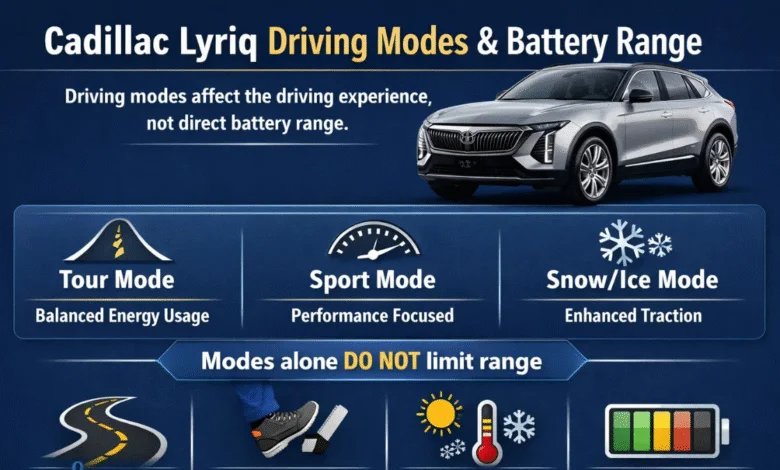
Do the Driving Modes in Cadillac Lyriq Offer Different Ranges or Battery Usages?
When people start exploring electric vehicles, one of the questions that comes up again and again is whether driving modes really matter in terms of range and battery usage. Do the Driving Modes in Cadillac Lyriq Offer Different Ranges or Battery Usages For the Cadillac Lyriq — a sophisticated, modern EV — this question has a multi‑layered answer. On the surface, driving modes don’t magically change the size of the battery or the EPA‑rated range. But in real‑world conditions, they absolutely influence how the battery is used, how quickly energy is consumed, and ultimately how far the vehicle can travel on a full charge.
If you want a deeper understanding of this system and how it plays out in everyday driving, you’re in the right place. Let’s unpack it in detail.
What Are Driving Modes and Why They Matter More Than You Think
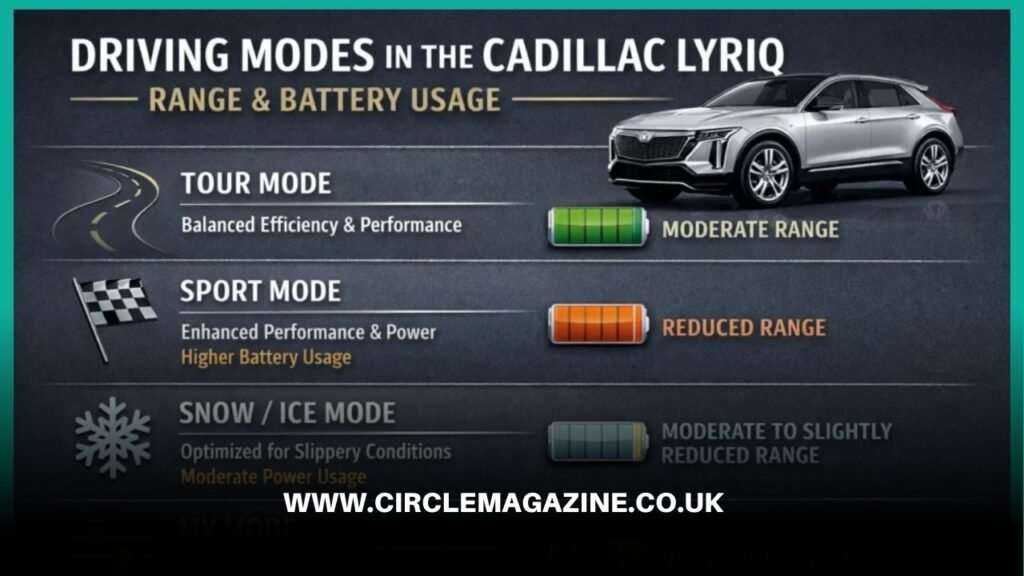
Do the Driving Modes in Cadillac Lyriq Offer Different Ranges or Battery Usages Driving modes are essentially different software configurations that adjust how the vehicle responds to your inputs and the road around you. In the Lyriq, these settings influence things like throttle sensitivity, regenerative braking strength, traction control behavior, and in some cases even how systems like steering effort and stability control are weighted.
Think of driving modes as a way of tuning the vehicle’s personality. One mode makes the Lyriq feel calm and efficient. Another makes it feel lively and ready to go. A third might prioritize traction and safety in less‑than‑ideal surface conditions.
From a purely technical standpoint, none of these modes change how much energy is stored in the battery pack. The capacity remains the same. But from a practical standpoint, they absolutely change how that stored energy is used, and that is where range and usage differ.
Why? Because energy consumption in an EV is not just about distance — it’s about how the motor, electronics, and systems use power during driving. A mode that pushes power harder will drain energy faster. A mode that recovers more energy when slowing down will preserve range. It’s that simple.
So yes, driving modes matter — not because they alter the physics of the battery, but because they influence the behavior of the vehicle and therefore how the battery is used.
Tour Mode: The Everyday Baseline for Balanced Efficiency
Tour Mode is the Cadillac Lyriq’s everyday default setting — the mode most owners will spend the majority of their time in. Do the Driving Modes in Cadillac Lyriq Offer Different Ranges or Battery Usages It’s optimized for a balanced experience, blending responsiveness, efficiency, and comfort.
When you select Tour Mode, throttle inputs are tuned to be smooth and predictable. The vehicle doesn’t jump at every tap of the accelerator, which means you’re less likely to use excess energy during normal driving. Regenerative braking is calibrated to recapture a meaningful amount of energy during deceleration — helping to slow the vehicle while putting power back into the battery.
One of the underrated aspects of Tour Mode is that it deliberately avoids extremes. It doesn’t make everything “max power” or “max regen.” Instead, it aims for a sweet spot where you get confident acceleration without wasting energy and effective regen without feeling abrupt.
In everyday commute situations — city driving, highway cruising, or mixed use — Tour Mode tends to deliver the best real‑world range because it encourages smooth, steady energy usage. Drivers who want to maximize range without sacrificing normal performance usually find this mode the most effective.
Tour Mode doesn’t give you dramatic savings in range — it simply avoids heavy losses. In comparison to more performance‑oriented modes, the battery stays at a healthier charge level longer under similar driving conditions. For many drivers, this makes Tour Mode the practical “go‑to” setting.
Sport Mode: Fun Comes at a Price (for the Battery)
If Tour Mode is about balance, Sport Mode is about excitement. It changes the driving dynamic in several ways that make the Cadillac Lyriq feel more engaging and responsive, but those changes impact how energy is used.
First, Sport Mode sharpens throttle response. This means that when you press the accelerator, the vehicle responds more quickly and with more intensity. This may feel great when merging onto a highway or navigating a twisty road, but it also uses more power in a shorter amount of time.
Second, in many vehicles including the Lyriq, Sport Mode often reduces the emphasis on regenerative braking. Why? Do the Driving Modes in Cadillac Lyriq Offer Different Ranges or Battery Usages Because the focus is on a seamless, driven‑car experience rather than maximum energy recovery. With less regen to capture energy during deceleration, more energy ends up unused in the drivetrain or dissipated as heat.
Steering and suspension behavior (if adaptive systems are present) may also be tuned for sharper feel rather than efficiency. While this improves the driving experience, it doesn’t help the battery.
The result is predictable: Sport Mode delivers more excitement at the cost of energy efficiency. If you drive aggressively in Sport Mode, you will almost certainly see your range drop compared to Tour Mode. Some drivers experience double‑digit percentage decreases in actual range when using Sport Mode extensively.
That doesn’t mean Sport Mode is bad. For short drives or situations where performance matters more than range, it can be a lot of fun. Just be aware that every moment you spend in that mode is likely trimming miles off your eventual reachable distance.
Snow/Ice Mode: Control Over Economy in Slippery Conditions
Snow/Ice Mode exists for one primary purpose: Do the Driving Modes in Cadillac Lyriq Offer Different Ranges or Battery Usages to make the vehicle easier to control in low‑traction conditions. Cold, wet, or slippery roads require a different approach to throttle and braking than dry pavement. Snow/Ice Mode adjusts vehicle behavior to avoid wheel spin and abrupt power delivery.
When engaged, throttle responsiveness becomes much gentler. This prevents sudden bursts of power from overwhelming traction and causing slip. Regenerative braking may also be tuned to slow the vehicle more gently, avoiding unexpected deceleration that could unsettle the car on slick surfaces.
From a battery usage standpoint, Snow/Ice Mode does not aim for efficiency. Its goal is controlled, stable motion. Because of that, energy usage tends to be slightly higher per mile than in Tour Mode — but this effect is often small compared to other factors like cold‑weather battery performance and heater usage.
It’s important to note that real‑world range Do the Driving Modes in Cadillac Lyriq Offer Different Ranges or Battery Usages in winter can be affected heavily by temperature alone, with or without Snow/Ice Mode engaged. Cold batteries inherently perform differently, and energy used for cabin heating can make up a big part of overall usage. The mode’s own influence on range is meaningful — just not the dominant factor in winter driving.
So, if your priority is confident traction and controlled behavior, Snow/Ice Mode delivers. If your priority is maximizing range, the default mode still wins — but not at the expense of safety in challenging conditions.
My Mode: Personalizing the Balance Between Efficiency and Performance
My Mode is where the Cadillac Lyriq blends flexibility with personalization. Instead of selecting a preconfigured set of behaviors, you get to dial in your own preferences: throttle response, steering feel, regenerative braking levels, and sometimes even traction behavior.
This means the impact on range and battery usage depends entirely on how you configure it. If you choose a setup with gentle throttle, strong regenerative braking, and conservative traction control, you can create a mode that rivals — and perhaps even slightly improves upon — Tour Mode’s energy usage in certain conditions.
On the other hand, if you set My Mode to mimic Sport Mode’s attributes, then your energy usage will mirror Sport Mode’s pattern — heightened acceleration, potentially lower regen emphasis, and therefore higher consumption.
The power of My Mode is in tailoring the driving experience to your exact preferences. It effectively lets you choose where on the spectrum between performance and efficiency you want the vehicle to sit. Do the Driving Modes in Cadillac Lyriq Offer Different Ranges or Battery Usages Do the Driving Modes in Cadillac Lyriq Offer Different Ranges or Battery Usages The trade‑off is that you need to understand what each setting does — and how it influences energy usage — in order to optimize for range.
Drivers who spend time experimenting with My Mode often discover they can fine‑tune a setup that fits their driving style while squeezing a bit more range out of everyday use. But it’s also easy to swing the other way, ending up with a configuration that favors performance.
One‑Pedal Driving: Not a Mode, But a Range Enhancer
While not technically one of the selectable driving modes, One‑Pedal Driving deserves special mention because of its impact on range. This feature increases the strength of regenerative braking so dramatically that lifting off the accelerator results in significant deceleration without needing to touch the brake pedal.
When used effectively, One‑Pedal Driving can capture a Do the Driving Modes in Cadillac Lyriq Offer Different Ranges or Battery Usages lot more energy during deceleration than traditional braking, which simply wastes kinetic energy as heat. This contributes directly to extending real‑world range, especially in urban or stop‑and‑go driving where frequent slowing creates opportunities to recover energy.
Many drivers find that using One‑Pedal Driving with Tour or My Mode enhances overall efficiency noticeably. In some conditions, it can provide several percentage points of additional range compared to coasting in a mode with lighter regen.
It’s a good reminder that range is not just about modes — it’s also about how you drive.
Putting It All Together: Modes Do Affect Range — Just Not the Way You Might Expect
So what’s the bottom line? Do the driving modes in the Cadillac Lyriq offer different ranges or battery usages?
Yes — absolutely.
But not because they change the battery’s capacity. Do the Driving Modes in Cadillac Lyriq Offer Different Ranges or Battery Usages The battery’s stored energy remains the same across all modes. What changes is how quickly that energy is used — through throttle response, regenerative braking, traction behavior, and other calibration factors.
In real‑world driving:
- Tour Mode tends to deliver the best balance and often the best achievable range for typical driving.
- Sport Mode increases performance responsiveness but uses energy at a faster rate, reducing range.
- Snow/Ice Mode prioritizes traction and control, with a modest impact on efficiency.
- My Mode allows personalized tuning that can either conserve energy or expend it faster, depending on your setup.
- One‑Pedal Driving — while not a mode — can significantly boost range by maximizing energy recuperation.
Understanding these differences is key if you’re focused on optimizing your EV experience. Driving modes don’t add miles to the battery, but they absolutely affect how those miles are used in everyday conditions.
Final Thoughts: Choose the Right Mode for the Right Moment
If range is your number one consideration, Do the Driving Modes in Cadillac Lyriq Offer Different Ranges or Battery Usages default to Tour Mode and take advantage of One‑Pedal Driving in city traffic. If you’re heading out for a spirited drive and want the most responsive feel, Sport Mode delivers — just be prepared for the battery gauge to move more quickly. In winter or slippery conditions, Snow/Ice Mode gives you peace of mind and control. And if you want something that perfectly fits your personal style, My Mode lets you build it yourself.
At the end of the day, driving modes in the Cadillac Do the Driving Modes in Cadillac Lyriq Offer Different Ranges or Battery Usages Lyriq don’t change the fundamentals of battery physics, but they absolutely change your driving experience — and the real‑world range you can achieve on a given charge.